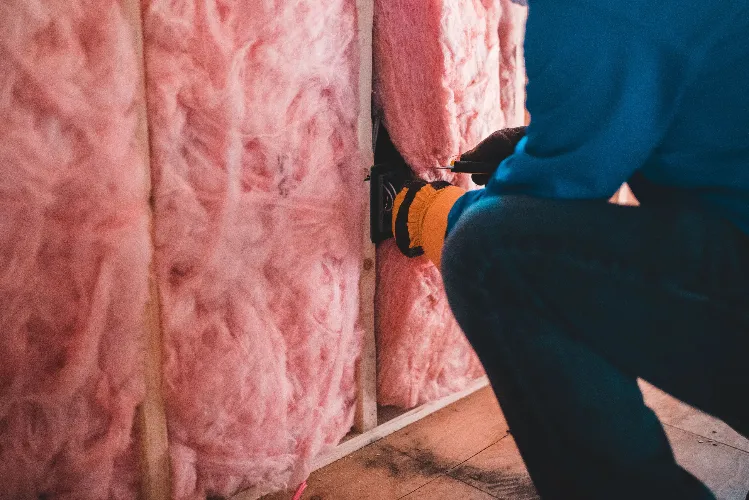
Thermally insulating the walls and roof of a single-family home is the passive energy-efficiency measure with the greatest impact on comfort and on the electricity bill. In warm climates like those of Alicante and Murcia, a detached or semi-detached house exposed to the sun blocks summer radiation and retains cool air, cutting the need for air conditioning by up to 50%. We analyse the three main solutions — SATE (external thermal insulation system), insufflated cavity filling and internal dry lining (trasdosado) — to assess which one delivers the best technical performance.
Why the thermal envelope is key in detached and semi-detached houses
In single-family homes, the area of facade and roof directly exposed to the outdoors is considerably greater than in a flat within a block. This total exposure makes the outer skin responsible for more than 40% of unwanted heat gains during the summer.
During the summer months on the Mediterranean coast, solar radiation heats brick facades and roofs massively, building up an enormous thermal mass that is continuously transferred into the rooms. This forces the air-conditioning units to run at full power all day and part of the night to keep the home habitable.
Proper insulation acts as a protective thermal shield: it retains the coolness generated indoors, blocks the entry of summer heat and stops the heating from escaping in winter.
Comparative analysis: SATE, insufflated cavity fill and internal dry lining
There is no single way to insulate a single-family home. Depending on the current state of the walls, the desired external aesthetic and the budget, there are three main techniques:
1. SATE (external thermal insulation system)
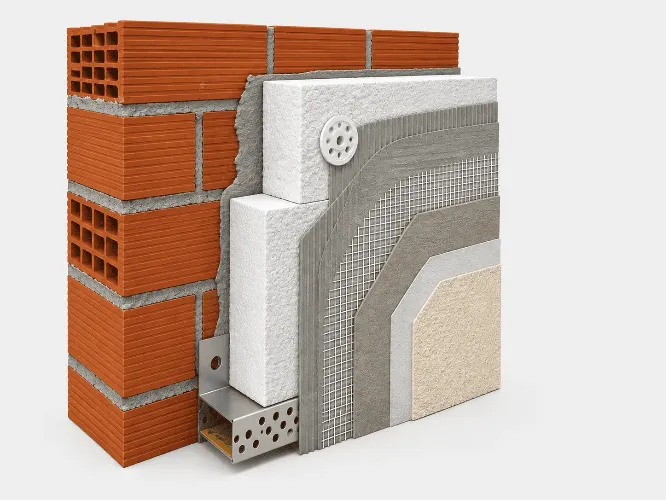
This technique consists of bonding and fixing insulation panels (graphite-enhanced expanded polystyrene EPS or mineral wool) directly onto the external face of the facade. A reinforcing mortar layer and a waterproof, breathable decorative finish are then applied on top.
SATE is the ideal solution for single-family homes, as it wraps the house completely from the outside, eliminating 100% of thermal bridges at columns, slab edges and terrace fronts.
- Advantages: Optimal thermal performance, complete aesthetic renewal of the facade, no loss of usable floor area indoors and no disruption inside the rooms.
- Drawbacks: Higher upfront investment than other techniques and the need to install scaffolding during the works.
2. Insufflated cavity fill
An injection technique in which the empty air cavities of the double-leaf brick wall (very common in detached and semi-detached houses built between 1970 and 2007) are filled with bulk insulation such as cellulose, insufflated mineral wool or graphite-EPS beads.
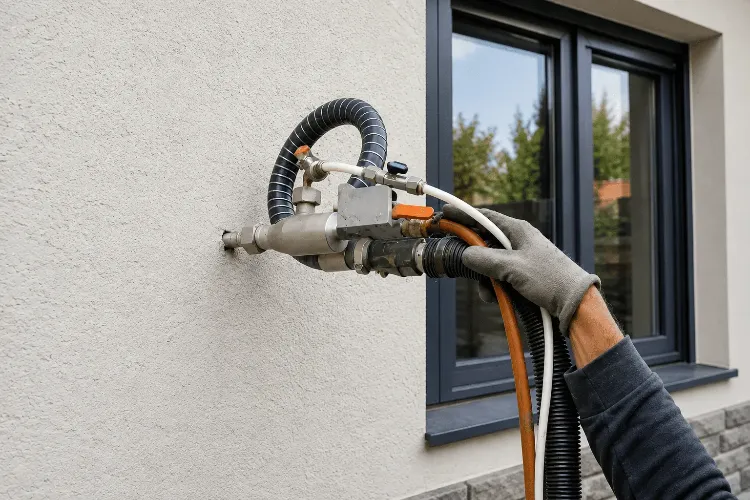
- Advantages: Ultra-fast installation (usually finished in 24 hours), excellent cost-effectiveness, no internal works and the external appearance is left completely untouched.
- Drawbacks: It requires the walls to have a continuous empty air cavity at least 4-5 cm thick.
3. Internal dry lining (trasdosado) with plasterboard
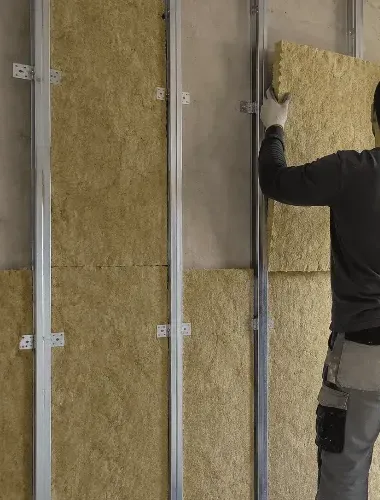
This solution involves erecting a metal sub-structure on the internal face of the external walls, filling the cavity with rigid rock-wool panels and closing it off with plasterboard (pladur).
- Advantages: It allows specific rooms or areas of the house with the greatest thermal impact to be insulated, and it also conceals new electrical or plumbing installations.
- Drawbacks: It takes between 5 and 8 cm of depth off each insulated wall and generates rubble and repainting work indoors.
Comparative table of insulation solutions
| Criterion | SATE (external) | Insufflated (cavity) | Dry lining (internal) |
|---|---|---|---|
| Thermal performance | Very high (100% thermal bridges eliminated) | Medium – high | High |
| Investment per m² | €70 – €110 / m² | €15 – €25 / m² | €40 – €60 / m² |
| Loss of interior space | 0 cm | 0 cm | 5 – 8 cm per wall |
| Works duration | 2 – 4 weeks | 1 day | 3 – 5 days |
| External aesthetic | Completely renewed | Unchanged | Unchanged |
Case study: real financial saving in a detached house in Alicante
To illustrate the economic return, let's look at a 140 m² single-family home in the province of Alicante, with 120 m² of usable sun-facing facade area and no insulation in the air cavity. During the summer and winter months, the owners suffer a rise in the electricity bill due to an air-conditioning and heating consumption of roughly 4,500 kWh/year.
By applying insufflated mineral wool or graphite EPS in the facade air cavity, the demand for heating and cooling is reduced by 45%.
Assuming an average electricity tariff of €0.22/kWh (including grid tolls and taxes):
With an estimated budget of around €2,400 for insufflating the facades, the investment is fully amortised in just over 5 years. From that point on, the owners enjoy a sustained direct saving of more than €440 per year on their electricity bill, plus immediate thermal comfort.
Tax deductions and public incentives
Bear in mind that insulation works on the envelope of primary residences that achieve a minimum reduction of 7% in heating and cooling demand may qualify for the IRPF (Spanish income tax) deduction for energy-efficiency improvement works. There are also public grant schemes managed by IDAE (the Spanish energy agency) and the regional government; to find out the current terms and subsidy percentages, check the active call in your municipality.