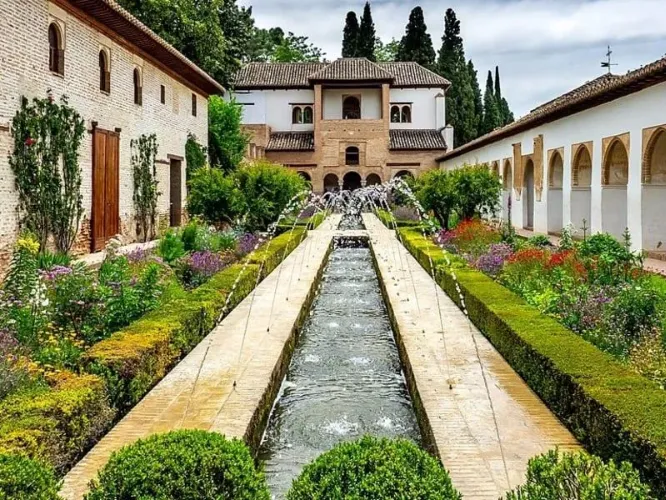
Ever since traditional Mediterranean architecture, water has been one of the most effective and elegant regulators of the microclimate. Integrating fountains and water sheets inside the home is a powerful bioclimatic strategy that lets you cool the ambient air passively, balance humidity and create spaces of great thermal, visual and acoustic wellbeing. In warm regions such as the province of Alicante and the Region of Murcia, bringing the water element into the home helps to combat summer heat while optimising indoor comfort.
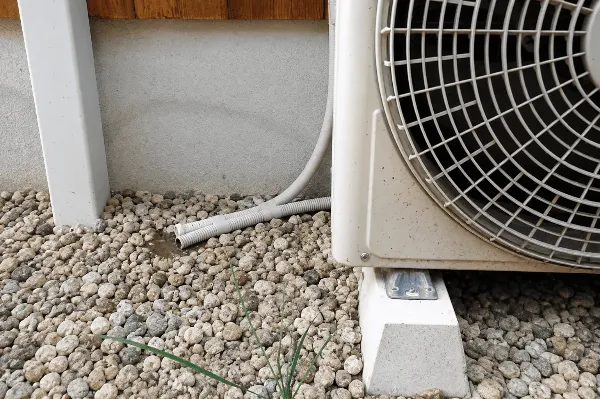
To feed these interior fountains efficiently and sustainably, there is an ideal resource that often goes unnoticed: the condensate water generated by the air-conditioning units themselves in summer. Instead of throwing this flow away down the drain, reusing it provides a continuous supply of cold, lime-free water. In this way, a low-temperature thermal mass is harnessed to create passive cooling surfaces, balancing the home's microclimate and intelligently improving indoor air quality.
Why make use of the condensate water from the air conditioning?
The condensation produced by an indoor unit is nothing more than ambient humidity precipitated on contact with the low-temperature cooling coil. This water has two thermodynamic and physical properties that are ideal for reuse inside the home:
- Low source temperature: The condensate water leaves the equipment at a temperature of between 10 °C and 15 °C. Instead of discarding that stored energy, we reintroduce that cold mass into the room.
- Absence of minerals (soft water): As it is naturally distilled water, it contains no lime or dissolved salts. This prevents the formation of crusts or scale on pumps, glass and stone panels of interior fountains, cutting maintenance to a minimum.
The "action range": performance according to the location of the home
The behaviour of this system adapts perfectly to both the humid coast and the dry interior of the Levante, offering a range of benefits specific to each area:
BIOCLIMATIC ACTION RANGE
- Coastal zone (Alicante/Murcia coast): MAXIMUM water production (3-4 L/h) | Maximum radiant "cold wall" effect | Comfortable humidity recovery | "Air washer" purifying effect
- Interior zone (dry heat): MEDIUM water production | High evaporative cooling | Correction of severe dryness | Respiratory comfort
1. In the coastal zone: maximum cold-water mass and radiant cooling
In homes near the sea (Playa de San Juan, Orihuela Costa, Torrevieja, La Manga), the high relative humidity of the outdoor air makes the air conditioning work by dehumidifying at a high rate.
- The benefit: The system generates a massive volume of condensate water (up to 3 to 4 litres per hour). By continuously pouring this flow of water at 12 °C over a glass or stone wall, radiant cooling ("cold wall" effect) is maximised. In addition, the optimal level of interior humidity (40–50%) is restored — a level that AC drops too far after hours of sealed operation.
2. In the interior: evaporative cooling and hygrometric comfort
In the inland districts (Valle del Vinalopó, Hoya de Alcoy, inland Vega Baja, Huerta de Murcia), summer temperatures are very high and the air is dry.
- The benefit: After several hours of climate control, indoor humidity can fall below 30%, causing dryness of the throat and eyes. The evaporation of some 1.5 litres a day from the fountain absorbs heat from the environment through passive evaporative cooling, refreshing the air and bringing humidity back to healthy levels.
The "cold wall" effect: passive, radiant cooling
Regardless of the zone, integrating a vertical fountain fed with condensate water creates a heat-exchange surface inside the living room that operates through two physical mechanisms:
1. Radiant cooling
The human body exchanges heat by radiation with the surrounding surfaces. By keeping a wall or glass sheet at a temperature below that of the ambient air thanks to the continuous flow of cold water, a direct radiant comfort sensation is generated, similar to the shade of a mountain cave.
2. Natural convection
Warm air in the room that comes into contact with the film of cold water at 12 °C gives up its sensible heat immediately, cooling and sinking by density. This creates a micro-circuit of fresh air in the lower part of the room without the need for fans.
Energy balance and impact on the home's consumption
Integrating an interior fountain does not mean sending the electricity bill sky-high. On the contrary: the water that evaporates naturally absorbs heat from the air without consuming a single watt, delivering passive cooling continuously.
Even though the air conditioning has to handle a small share of that humidity to keep the room at an optimal balance point, today's Inverter units are extremely efficient. In practical, everyday terms:
- Negligible energy impact: The home's overall electricity consumption rises by barely 1% to 3% (which comes to just €0.03 to €0.05 a day, derived only from the continuous operation of the micro-circulation pump and the LED/UV lighting).
- Leap in thermal comfort: The radiant freshness sensation in the room and the elimination of ambient dryness raise the occupants' perceived comfort by more than 25%.
- Improved air quality: The purity of the indoor environment improves by up to 30%, as the water sheet acts as a natural moist trap that captures fine dust particles and airborne allergens.
In short, for a practically imperceptible energy cost, the home gains a substantial improvement in wellbeing, respiratory health and environmental balance.
Bioclimatic sizing and design criteria
To achieve a noticeable thermal and humidification impact on the environment, the bioclimatic sizing rule requires an exposed water surface equivalent to 1 m² of fountain per 15 to 20 m² of room.
What matters when it comes to cooling and regulating humidity is not the water volume in the tank, but the active frontal surface (width × height) down which the water sheet slides in direct contact with the air.
Recommended dimensions according to room size
| Living-room / room size | Recommended active water surface | Indicative panel dimensions (width × height) |
|---|---|---|
| Bedroom / study (15–20 m²) | ~1.0 m² | 0.6 m × 1.8 m |
| Standard living room (25–35 m²) | 1.5 – 2.0 m² | 1.0 m × 1.8 m to 1.0 m × 2.0 m |
| Open-plan area / living-diner (40–50 m²) | 2.5 – 3.0 m² | 1.5 m × 2.0 m (or two panels of 0.8 m × 2.0 m) |
Key factors of thermal performance
- The reach of radiant comfort: The "cold wall" effect is felt with maximum intensity within a radius of 2 to 3 metres from the fountain. For that reason, it is more effective to place the panel near the sofa area or the dining table than in a walk-through corridor.
- Required pump flow: For a sheet flowing over glass or stone to absorb heat efficiently without breaking the surface tension or splashing, it needs a constant recirculation flow of approximately 10 to 15 litres per minute per metre of panel width.
- Effectiveness limit: Panels below 0.8 m² in a medium-sized living room will remain a purely decorative element, without enough cold mass to change the radiant temperature or raise the relative humidity of the space.
Types of visible water fountains: technical analysis and indicative costs
When it comes to integrating an interior fountain fed by air-conditioning condensate, both aesthetics and financial investment, as well as splash control, need to be weighed up:
1. Water wall on glass (continuous panel)
It consists of a sheet of tempered glass mounted vertically, down which the water slides, held by surface tension.
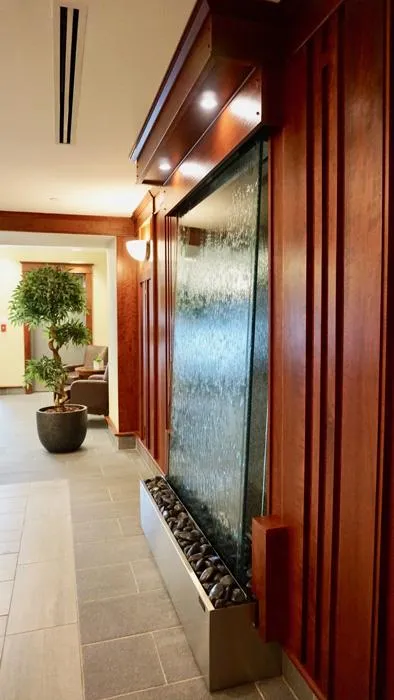
- Splash: None.
- Key advantage: By using condensate water (lime-free), the glass stays 100% transparent and stain-free. It takes up very little useful space (10–15 cm depth).
- Approximate installation cost: €800 – €2,500 (depending on the dimensions and on whether the tempered glass is bespoke or screen-printed).
2. Water wall on stone or slate
The water slides down a rough natural stone surface (slate, granite) or ceramic relief.
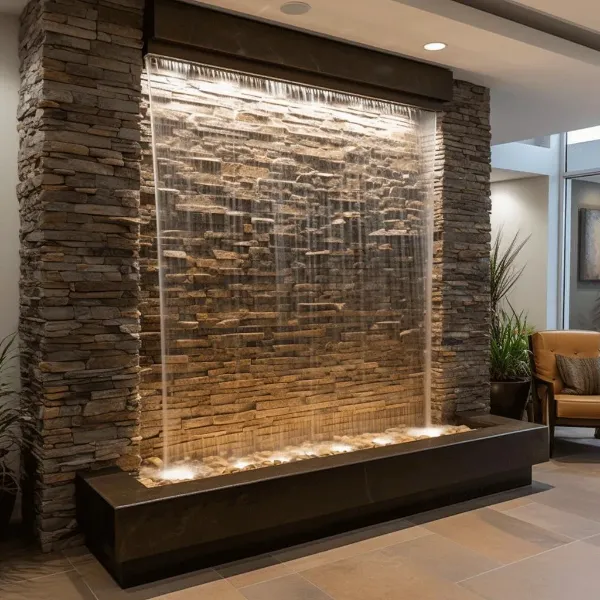
- Splash: Very low.
- Key advantage: The roughness increases the contact area with the air, boosting heat exchange and providing a very natural water sound that dampens outside noise.
- Approximate installation cost: €600 – €1,800 (depending on the type of finish and the rear waterproofing treatment).
3. Water curtain by threads
Formed by vertically tensioned steel or mylar cables or threads, down which the droplets slide in a guided, individual manner.
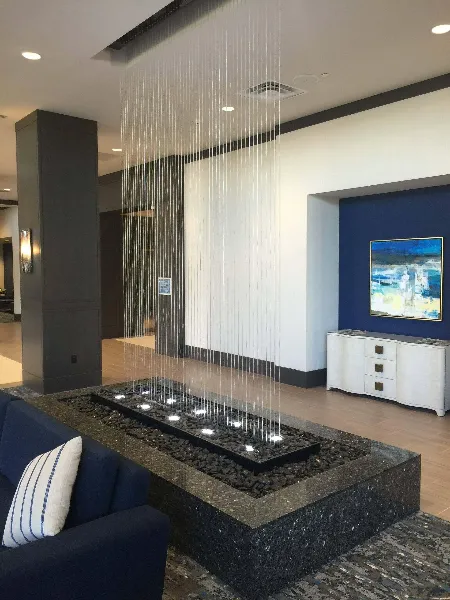
- Splash: None.
- Key advantage: Spectacular as a room divider (separator between living room and dining room) without cutting off the natural light path.
- Approximate installation cost: €1,800 – €4,500 (high-end / exclusive architectural design solution).
Overall comparison of solutions
| Fountain type | Estimated investment | Cooling efficiency | Humidification efficiency | Splash | Sound | Maintenance with condensates |
|---|---|---|---|---|---|---|
| Glass wall | €800 – €2,500 | High (excellent radiant conduction) | Medium (stable sheet with low micro-evaporation) | None | Very soft | Very low (no lime marks) |
| Stone/slate wall | €600 – €1,800 | Very high (thermal inertia + accumulated cold mass) | High (roughness increases water-air contact surface) | Very low | Medium | Low (resistant texture) |
| Thread curtain | €1,800 – €4,500 | Medium (no solid support to accumulate cold mass) | High (droplets exposed 360° to the air flow) | None | Soft / rhythmic | Medium (tension adjustment) |
Indoor Air Quality (IAQ): the "air washer" effect
Beyond the thermal aspect and the regulation of relative humidity (keeping it in the optimal band of 40–50%), an interior fountain acts as a wet scrubber.
By making the air of the home circulate over the moving water sheet, airborne particles, fine dust and pollen are trapped in the tank water. To guarantee the maximum hygiene of the circuit, the recirculation tank should incorporate a basic mechanical filter and a small clarifier based on an ultraviolet LED lamp (\(UV\text{-}C\)), keeping the water biologically pure on a continuous basis.
Conclusion
Harnessing the condensates of air conditioning to feed a water fountain inside the home is an excellent example of applied bioclimatic design. It lets us turn an unused by-product into a source of visual, acoustic and thermal comfort, protecting indoor air quality and improving the overall efficiency of the home, in coastal villas as well as in inland residences.