Often overlooked in basic residential installations, the thermostatic mixing valve (VMT — válvula mezcladora termostática) fitted at the outlet of the DHW (domestic hot water, in Spain ACS) cylinder or water heater is one of the plumbing accessories with the highest return on investment on the market. For a marginal cost (between €40 and €80 for the equipment plus fittings), this mechanical device automatically regulates the blend of stored hot water with cold mains water, delivering a constant flow to the home at the desired usage temperature (typically between 38 °C and 42 °C).
Under Spanish legionellosis prevention rules (Royal Decree 487/2022 and UNE 100030), water stored in tanks must be kept at a minimum of 60 °C to eradicate bacteria. However, distributing water at 60 °C directly to the taps entails a severe scalding risk and massive energy waste. The thermostatic mixing valve resolves this thermodynamic contradiction passively and automatically.
The four great technical virtues of the thermostatic mixing valve
1. Guaranteed anti-scald safety
At 60 °C, human skin suffers third-degree burns in under five seconds. By installing a VMT certified to UNE-EN 1111 at the generator outlet, the water sent through the distribution network is automatically limited to a safe temperature (e.g. 40 °C). If the cold mains supply is cut for any reason, the valve mechanically locks in milliseconds to prevent dangerous thermal shocks.
2. Multiplying the useful hot-water autonomy
Storing water at a higher temperature (e.g. 65 °C instead of 45 °C) and blending it via the VMT at the outlet expands the tank's equivalent capacity without increasing the physical size of the unit.
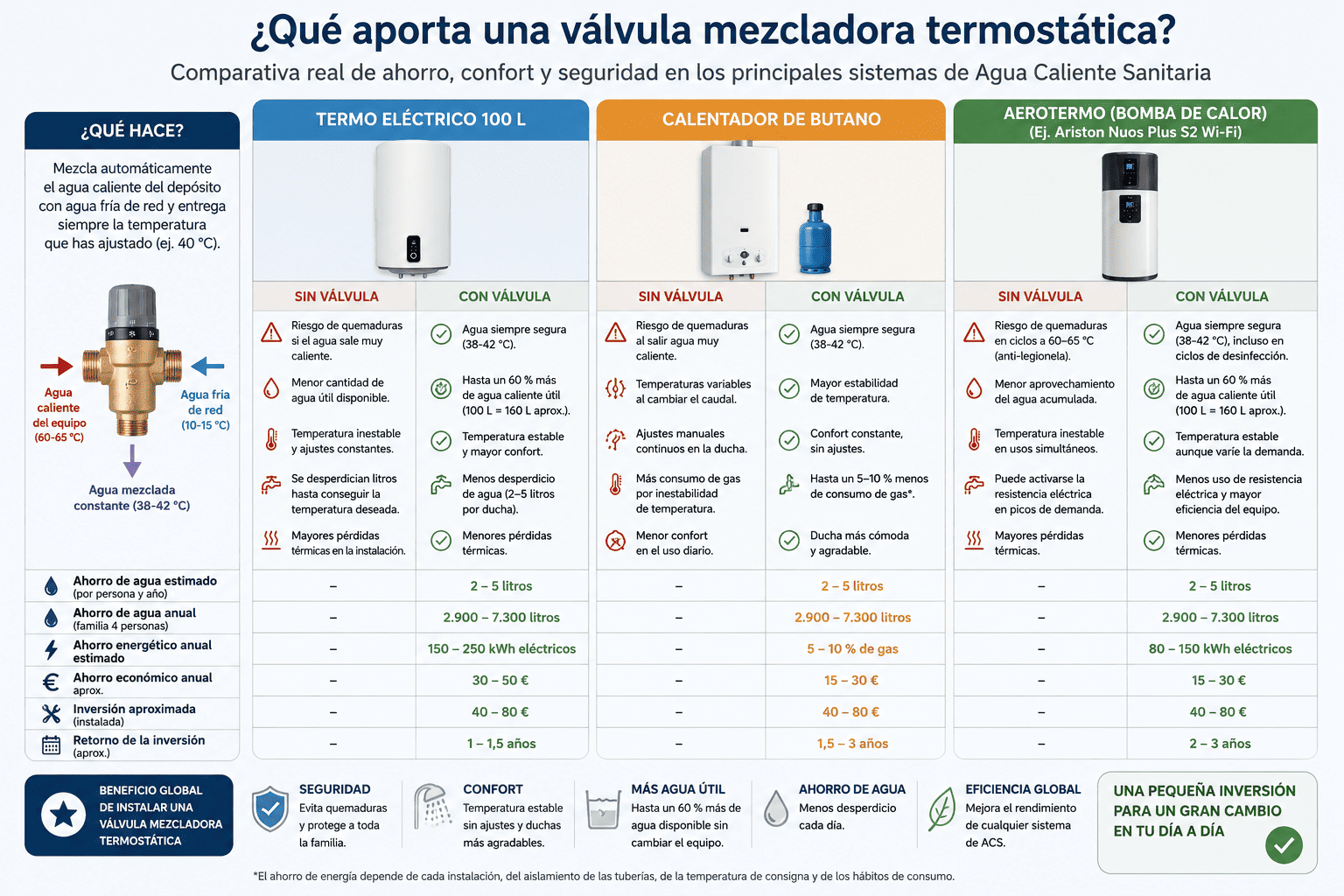
Volumetric effect: a 100-litre tank stored at 65 °C, blended to 40 °C with 15 °C mains water, delivers approximately 160 litres of usable shower water. This is equivalent to increasing the tank's useful autonomy by 60%, allowing a compact unit to serve four people without running out of hot water.
3. No more adjustment time and direct water savings
Without a VMT, the user must manually adjust the tap or thermostatic shower controls every time they bathe, balancing flow rates and temperatures.
According to consumption-habit studies by AEAS (Spanish Association of Water Supply and Sanitation), 3 to 5 litres of clean water are wasted per shower simply waiting for and regulating the mix at the tap. With the VMT delivering water directly at 40 °C from the main pipe, adjustment is instantaneous.
4. Reducing thermal losses in pipework
As water no longer circulates at 65 °C through the whole plumbing network of the home but at the set 38 °C–42 °C, thermal losses by conduction and radiation in embedded pipes are substantially reduced, in line with the heat-transfer principles laid out in the RITE (Spanish Regulation for Thermal Installations in Buildings).
Impact of the mixing valve by generation technology
The behaviour and financial savings from installing a mixing valve vary significantly depending on the water-heating system used:
A. Conventional electric water heater (Joule effect)
The problem without a VMT: if the user sets the heater's thermostat to just 45 °C to avoid scalding, they exhaust the 100 L quickly and encourage bacterial growth. If they raise it to 65 °C, they waste energy blending at the tap and run a scalding risk.
Benefit with a VMT: the heater set point can be raised to 65 °C to maximise energy storage and disinfection, while the VMT delivers water at 40 °C. Electrical energy savings of 8% to 12% are achieved by reducing the total volume of overheated water lost during tap regulation.
B. Butane water heater (instantaneous gas)
The problem without a VMT: instantaneous gas heaters suffer severe temperature fluctuations with flow rate. When trying to temper the water by opening the cold tap in the shower, pressure at the heater drops, causing the burner to shut off and producing the dreaded "cold-water blast".
Benefit with a VMT: by stabilising the mix at the outlet or on a recirculation/storage loop, constant tap fiddling is avoided, cutting the burner's on/off cycling, extending the equipment's service life and saving up to 10% on gas bottle consumption.
C. On a heat pump water heater (e.g. Ariston Lydos Hybrid)
Offers for heat pump kits Ariston Lydos Hybrid
The problem without a VMT: heat pumps reach their maximum \(COP\) (coefficient of performance) working at moderate storage temperatures (50 °C to 55 °C). However, when they run their periodic anti-legionella disinfection cycles, ramping up to 65 °C via the resistance element, the water comes out boiling.
Benefit with a VMT: it makes the most of tank stratification and anti-legionella cycles with total safety. Furthermore, by increasing the water available through blending, it prevents the heat pump's backup resistance from kicking in on brief demand peaks, keeping the unit operating 100% in efficient heat-pump mode.
Quantitative comparison: energy savings, water savings and ROI of the mixing valve
To calculate the economic impact we use the following standard figures for a four-person household (1,460 showers/year) with a demand of \(3{,}000\text{ kWh}_{\text{thermal}}/\text{year}\) (IDAE — Spanish Institute for Energy Diversification and Saving):
Water price (supply + sanitation): €2.20/m³ (€0.0022/litre) based on average data from AEAS and INE (National Statistics Institute).
Water waste avoided per shower: 3.5 litres/shower \(\rightarrow\) 5,110 litres/year saved. According to the Study on Water-Saving Potential in Indoor Residential Uses in Spain.
Reference electricity tariff: €0.20/kWh (REE — Spanish grid operator).
Butane bottle price: €18.80.
Average cost of the installed thermostatic mixing valve: €60 (one-off investment).
Conclusion
A thermostatic mixing valve at the outlet of any DHW generator is the lowest-cost, highest-relative-impact technical upgrade in residential plumbing. For just €60 it not only eliminates the risk of household scalding at the root and increases the tank's effective autonomy, but also pays for itself in between 10 months and 2 years thanks to combined savings of thousands of litres of tap water and 10% of the energy consumed. An essential component to crown the efficiency of electric water heaters, gas heaters or modern heat pump water heater systems.