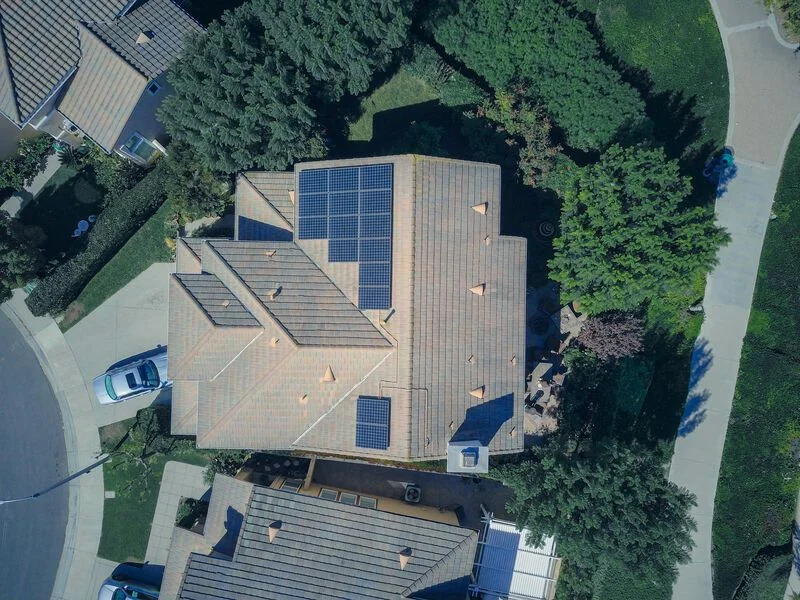
It's the first question anyone asks: "how many panels do I need?" The answer isn't a magic number — it depends on your consumption, where you live, and the quality of the installation. The good news: it's calculated with a simple formula that you can apply yourself with your electricity bill in front of you.
Start with your consumption
Take your latest bill and look up the annual consumption in kWh (most retailers show it in a chart of the last 12 months). Divide by 365 and you get your average daily consumption, \(E_{day}\). For a typical Spanish home it's around 8–10 kWh per day.
Tip: if you're on a time-of-use tariff, look at when you consume too. Self-consumption pays off more the more of your usage falls during daytime: the washing machine at midday is worth more than at midnight.
The sizing formula
The number of panels \(N\) comes from three factors:
- \(P_{panel}\) — power of each panel in kW. Today's modules are around 0.45 kW (450 W).
- \(PSH\) — peak sun hours: your area's equivalent daily irradiation. The Spanish south-east has some of the highest figures in Europe.
- \(PR\) — performance ratio: the real losses of the system (temperature, wiring, inverter, soiling). An honest value is 0.8.
A real example in Murcia
A home consuming 9 kWh/day, 450 W panels and the 5.2 PSH annual average of the Murcia Region:
Five panels, about 2.25 kWp installed. In practice we usually recommend rounding up a notch if the roof allows it: annual module degradation (~0.4%) and future consumption.
And when does it pay back?
The maths is straightforward once you know your estimated annual saving:
With today's prices and surplus compensation, a well-sized installation in the Levante typically pays back in 5 to 7 years, with a service life above 25.
The next step
This formula gives you an order of magnitude, but every roof has its own orientation, shading and tilt. Try our calculator to get an idea of how much you can save, and contact our team for a personalised study free and with no strings attached.