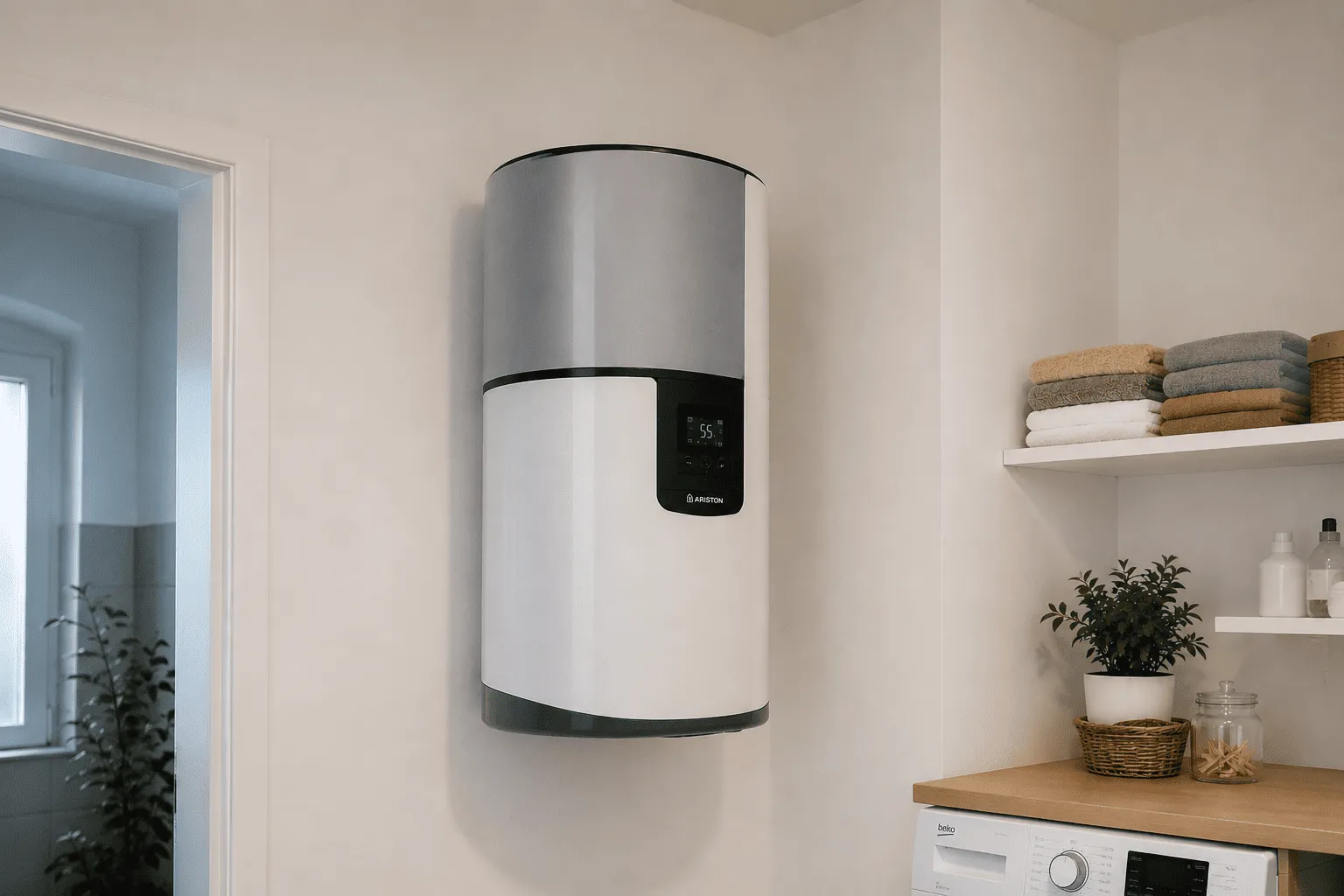
The forgotten big consumer at home
When we think about cutting the energy bill in a home, we usually think of installing solar panels, improving insulation, changing the windows or replacing appliances with more efficient models. However, there is one piece of equipment that works 365 days a year and, surprisingly, tends to go unnoticed:
The system in charge of producing domestic hot water (DHW).
Every shower, every hand wash, every kitchen sink and every dishwasher cycle needs hot water and, therefore, energy. According to the Institute for the Diversification and Saving of Energy (IDAE, Spain's national energy-efficiency agency), domestic hot water is one of the most significant energy consumers in the home. In fact, when it comes to replacing this equipment, IDAE itself recommends swapping conventional systems for heat-pump-based solutions (aerothermal energy) whenever possible, given their high energy efficiency (energy-saving recommendations according to the IDAE).
The reality is that many homes still use exactly the same technology as decades ago: a simple, reliable system — but also one of the least efficient in energy terms. Today, fortunately, there are alternatives able to deliver the same comfort while using far less energy.
But before deciding which is the best option, it's worth understanding how each of them works.
The four most common technologies
Currently, the vast majority of homes use one of these four systems to produce domestic hot water:
- Conventional electric water heater
- Butane gas heater
- Hybrid heat pump water heater
- Heat pump water heater
Although they all serve exactly the same purpose, there is a fundamental difference between them: they don't all need the same amount of energy to produce the same amount of hot water.
It is precisely that difference that will determine how much we pay on our energy bill over the coming years.
In this article we'll analyse each technology objectively, comparing how it works, its consumption, advantages, drawbacks and the real cost of using it in a home.
How does each technology work?
1. Conventional electric water heater
The electric water heater is still one of the most installed systems in Spain thanks to its low cost and simple installation. Its operation is very straightforward: an electric heating element inside the tank turns electricity directly into heat. That heat is transferred to the stored water, which stays hot until we use it.
It is a very reliable technology with little maintenance. However, it also has an important limitation. All the energy needed to heat the water comes exclusively from the electricity we buy from the grid. There is no additional harnessing of energy, so its efficiency is limited and electricity consumption tends to be considerable, especially in homes with several occupants.
| Advantages | Drawbacks |
|---|---|
| Low purchase price. | High electricity consumption. |
| Simple installation. | High electricity consumption. |
| Little maintenance. | Higher long-term running cost. |
| Wide range of models and capacities available. | Makes poorer use of a PV self-consumption installation without smart management. |
2. Butane gas heater
For many years, the butane gas heater was the most common alternative to the electric water heater. Unlike the latter, it does not store hot water in a tank. It produces hot water only when we open a tap. This instantaneous operation avoids keeping a tank hot all day long and cuts certain energy losses.
Historically, the cost of gas was also lower than that of electricity, which is why many homes chose this technology. It does, however, have some limitations. It depends on the regular delivery of gas cylinders. It requires proper flue gas evacuation. It needs periodic safety inspections and, most importantly in today's context, it can't directly take advantage of the energy produced by a PV installation.
For this reason, more and more owners are opting for fully electric, high-efficiency solutions.
| Advantages | Drawbacks | Traditionally competitive running cost. | Dependence on cylinder supply. |
|---|---|
| Virtually unlimited hot water while gas supply lasts. | Requires flue gas evacuation. |
| No storage tank required. | Periodic inspections. |
| Does not take advantage of PV surplus. |
3. Hybrid heat pump water heater
In recent years an especially interesting technology has appeared for those who want to replace an electric water heater without major building works. Such is the case of our Ariston Hybrid Wi-Fi heat pump water heaters.
It combines two different technologies in a single unit. On one hand, it incorporates a heat pump that harnesses the energy contained in the air to heat the water very efficiently. On the other, it retains an electric heating element that only kicks in when it's necessary to speed up heating or cover peak hot-water demand.
The result is a system that offers significantly lower consumption than a conventional water heater, keeping very similar overall dimensions and making replacement much easier. According to Ariston's official specifications, the Lydos Hybrid Wi-Fi can achieve savings of up to 50% compared with a conventional Class B electric water heater, thanks to its hybrid technology and the intelligent i-Memory system, which learns the user's consumption habits to automatically select the most efficient operating mode (Ariston).
It also includes Wi-Fi connectivity to control the unit from a mobile phone, hourly programming and different operating modes focused on savings and comfort. In our opinion, it represents a very balanced solution for those who want to improve their home's efficiency without undertaking a major refurbishment.
| Advantages | Drawbacks |
|---|---|
| Up to 50% less consumption than a conventional water heater, according to the manufacturer. | Lower efficiency than a dedicated heat pump water heater. |
| Easy replacement of an existing water heater. | Needs minimum ventilation conditions to deliver full performance. |
| Wi-Fi connectivity. | Higher initial investment than conventional units. |
| Intelligent i-Memory system. | |
| Excellent ratio between investment and saving. |
4. Heat pump water heater
The next step up in efficiency is represented by units such as the Ariston Nuos Plus S2 Wi-Fi.
In this case, practically all of the water heating is done by a larger-capacity heat pump. Instead of relying partly on an electric heating element, the heat pump does almost all the work by harnessing the energy present in the air. This allows electricity consumption to be cut even further and higher performance to be achieved.
According to Ariston, this range is designed to deliver the maximum energy efficiency in the production of domestic hot water via aerothermal technology, making it one of the most efficient solutions currently available for residential use (Ariston).
In return, it normally requires:
- more space for installation;
- proper air circulation;
- a higher initial investment.
When these conditions are met, it is probably the best option for those seeking maximum possible efficiency.
| Advantages | Drawbacks |
|---|---|
| Maximum energy efficiency. | Higher initial investment. |
| Lower electricity consumption. | More demanding installation. |
| Excellent integration with PV self-consumption installations. | Requires more available space. |
| Ideal for new-build homes or full refurbishments. |
Economic comparison
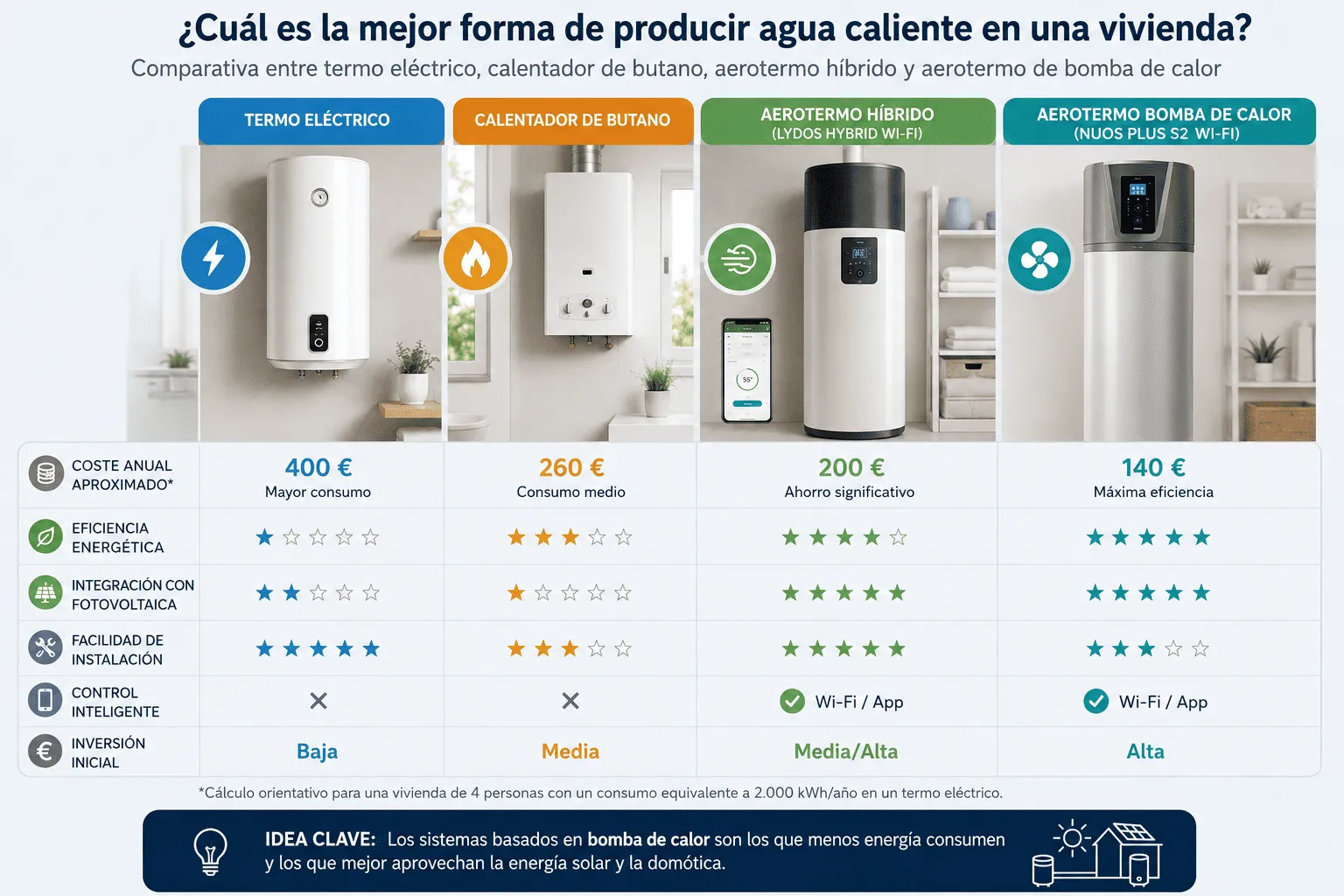
The real cost: how much money can each system save?
So far we've seen how each technology works and what its main advantages and drawbacks are. But when the moment comes to make a decision, the question is usually much simpler:
Which one will make me spend the least money over the coming years?
To answer this we'll use a representative example of a Spanish home. We are not trying to obtain an exact figure valid for every household, since consumption will depend on the number of people, usage habits and the price of energy. The aim is to compare the different technologies under the same conditions.
Study scenario
For this comparison we'll consider:
- A home for 4 people.
- Annual hot-water consumption equivalent to 2,000 kWh of electricity using a conventional water heater.
- Average electricity price: €0.20/kWh.
- Indicative butane price: €0.11/kWh useful.
- Similar usage throughout the year.
Note: energy prices can vary between retailers and over time. The example is intended to show the differences between technologies, not to calculate the exact cost for a specific home.
How much does each system really consume?
Taking the same level of comfort as a reference, we obtain the following estimate:
| System | Energy needed per year | Approximate annual cost | Annual saving (vs. an electric water heater) |
|---|---|---|---|
| Electric water heater | 2,000 kWh | €400 | — |
| Butane heater | ≈ 2,400 kWh of gas | €260 | €140 |
| Hybrid heat pump water heater (Lydos Hybrid Wi-Fi) | ≈ 1,000 kWh | €200 | €200 |
| Heat pump water heater (Nuos Plus S2 Wi-Fi) | ≈ 700 kWh | €140 | €260 |
As can be seen, they all deliver exactly the same amount of hot water. The difference lies in the amount of energy required to do so.
Heat-pump-based units harness the energy contained in the air to multiply the performance of every kilowatt-hour of electricity consumed. This is why IDAE promotes this kind of solution when heating and domestic hot-water systems are being renewed.
Seen another way:
- The butane heater cuts running costs, though it keeps the dependence on gas.
- The Lydos Hybrid achieves roughly half the consumption of an electric water heater, while keeping a very similar installation.
- A heat pump water heater such as the Nuos Plus offers the lowest energy cost of all, though it requires a higher initial investment and more demanding installation conditions.
The most common mistake when choosing a unit
When it's time to replace an electric water heater, many people take the decision based solely on the purchase price. It's completely understandable. However, that initial investment represents only part of the total cost.
An electric water heater can remain in service for 12 or 15 years, running practically every day. Over that time, the money we'll spend on energy is usually much greater than the price we paid for the unit itself.
For this reason, a decision based solely on purchase cost can end up being the most expensive option in the long run.
Beyond the economic saving
Although saving money is one of the main reasons to switch technology, it isn't the only one. More modern equipment also brings important day-to-day advantages:
- Greater stability of water temperature.
- Hourly programming.
- Control from a mobile phone.
- Intelligent operating modes.
- Lower environmental impact thanks to lower energy consumption.
- Better integration with PV self-consumption installations and home automation systems.
All of this improves not only the efficiency of the home, but also the comfort of its occupants.
The perfect companion for a PV installation
If your home has solar panels, changing the hot-water production system can have an even greater impact on the electricity bill.
Why?
Because a PV system produces most of its energy during the central hours of the day. However, in most households the biggest hot-water consumption happens in the morning and, above all, at night.
At first glance this looks like a problem. In reality it's a great opportunity.
When we talk about storing energy, most of us immediately think of a lithium battery. However, there's another much simpler and cheaper way of storing energy. Storing heat.
Every time the heat pump water heater heats the tank using the energy produced by the solar panels, that energy is stored as hot water until the moment we need it. In other words:
The hot-water tank behaves as a thermal battery. The difference is that in this case we aren't storing electricity, but heat. And we do it without installing additional batteries and without changing our consumption habits.
Why is it better to consume the energy than to export it?
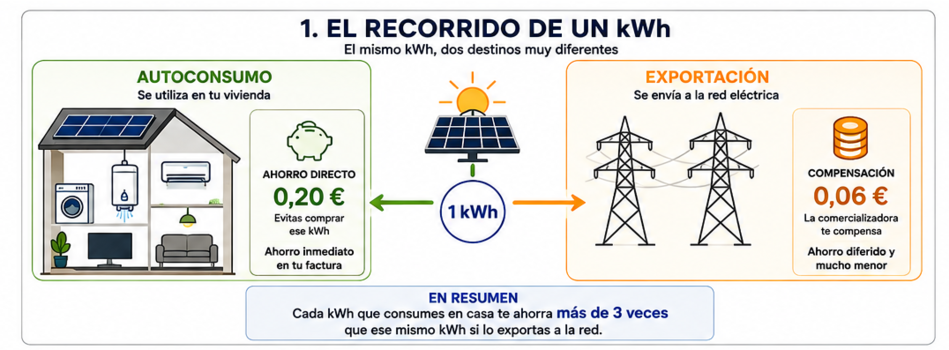
In Spain, the energy we export to the grid is normally compensated financially on the bill. However, the price that retailers pay for that surplus is generally much lower than the price at which we later buy electricity.
Let's assume that during a sunny day our PV installation generates more energy than the home needs. We have two options:
Option 1. Export the energy
The surplus energy is injected into the grid. The retailer compensates us at around €0.06/kWh for that surplus (indicative value that may vary depending on the tariff signed).
Later on, at night or on a cloudy day, we'll need to buy electricity to produce hot water. That energy will cost around €0.20/kWh, meaning for every kilowatt-hour we sold, we can barely buy back a third when we need it.
Option 2. Use the surplus to heat water
Instead of exporting that energy, the heat pump water heater switches on automatically and heats the tank while the solar panels are producing.
By nightfall, the water is already hot. We don't need to buy electricity again. In this case, every kilowatt-hour produced by the panels is used in full inside the home, and that translates into greater savings.
When home automation comes into play
So far we've assumed that the heat pump water heater runs on programmed schedules. But today's technology allows us to go one step further. A home automation system can automatically decide the best moment to produce hot water.
Not by following a fixed schedule, but by analysing in real time what's happening in the home.
For example, it can detect that:
- the PV installation is generating surplus;
- the home battery is already fully charged;
- the household consumption is very low;
- the weather forecast points to a drop in solar production the next day.
At that moment, the system can automatically activate the heat pump water heater to make use of the available energy. It all happens without user intervention. There's no need to change schedules or switch the unit on manually — the home takes the decision for us.
Which system to choose depending on your home?
After analysing the main technologies, it's easy to reach one conclusion:
There is no single perfect system for every home.
The choice will depend on the available space, the budget, the number of people living in the home and, above all, whether the home has a PV installation. A hot-water system runs practically every day of the year.
For that reason, energy consumption and running cost will end up weighing much more heavily than the initial investment.
In our opinion:
- An electric water heater is still a simple solution for homes with very sporadic use.
- A butane heater remains a valid alternative where a gas installation already exists and no other energy upgrades are being considered.
- A hybrid heat pump water heater is an excellent option to replace a conventional water heater without complications, notably cutting electricity consumption.
- A heat pump water heater offers the highest level of efficiency and is particularly recommended for new-build homes or full refurbishments.
It isn't about finding the most expensive or the most sophisticated unit — it's about choosing the one that best fits the real needs of the home.
Conclusion
The way we produce hot water in our homes has changed enormously in recent years. Today we have technologies capable of delivering the same level of comfort while using much less energy than traditional systems needed. And if we combine this equipment with a PV installation and a home automation system, the result is even more interesting.
The home learns when to produce hot water, automatically takes advantage of the solar surplus and reduces the energy bought from the grid to a minimum. Not only do we get a lower electricity bill: we also enjoy a more comfortable, more efficient home that's ready for the future.
As we've seen throughout this article, the best technology isn't the same for everyone. However, there's one idea common to every home:
The cheapest energy is the one we use efficiently.
And when we manage to produce hot water with less energy, making better use of what the home itself already generates, we're taking an important step towards a more efficient, more sustainable and smarter home.