The window is the most vulnerable and active point of a building's thermal envelope: representing only between 10% and 15% of the façade area, it is responsible for up to 35% of heating losses in winter and more than 40% of the heat entering in summer. In areas such as Murcia or Alicante, where summer solar radiation is extreme and winters require moderate but continuous use of climate control, addressing façade openings is the measure with the greatest impact on comfort. We comprehensively analyze frame technologies (PVC vs. Thermal Break Aluminum), the secrets of glazing (Low-E, Argon Gas and Solar Control), the impact of the roller shutter box and the actual costs of each alternative.
1. The Physics of the Thermal Opening: Why the Window Is the Critical Point
Unlike façade walls or the roof —which are opaque elements—, the window is an active thermal opening exposed to three simultaneous mechanisms of energy transfer:
- Thermal conduction: Heat flows through the frame and glass from the warm side to the cold side. An old uninsulated aluminum window has a high overall thermal transmittance (Uw ≈ 5,7 W/(m2·K)), four times higher than that of an uninsulated brick wall.
- Air Infiltration (Permeability): Gaps in traditional sliding windows and the roller shutter box mechanism allow outside air to enter directly. Up to 15% of energy expenditure is lost simply through air entering via the roller shutter strap opening.
- Direct Solar Radiation (Greenhouse Effect): During the summer months in the Levante region (Murcia and Alicante), radiation on East-, South- and West-facing façades is intense. Sunlight passes through transparent glass and heats interior surfaces. This infrared heat becomes trapped inside the room, driving up air-conditioning consumption.
Replacing an inefficient window eliminates the so-called "cold wall effect" in winter and the "greenhouse effect" in summer, while also eliminating water condensation on the glass in the mornings.
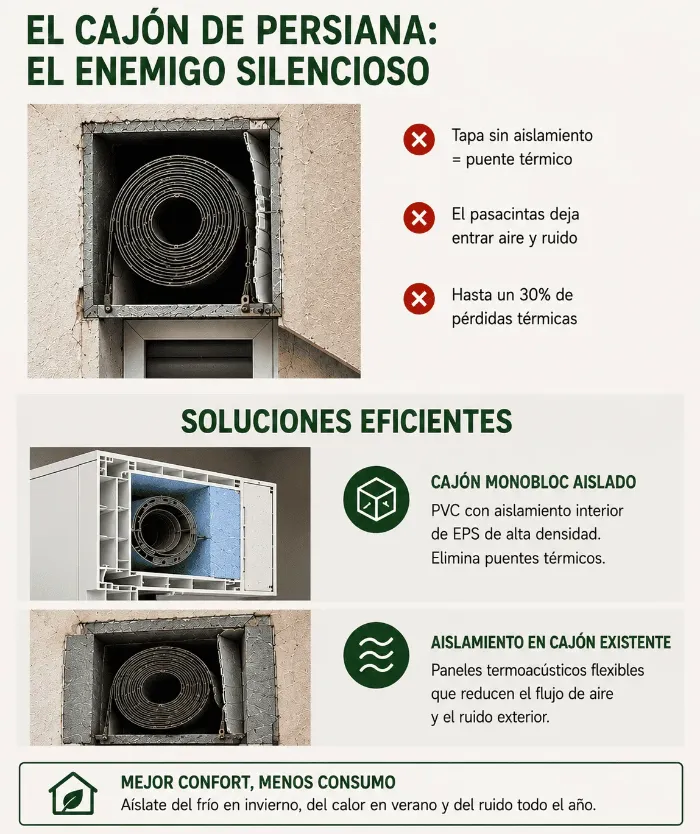
2. The Roller Shutter Box: The Window's "Silent Enemy"
Installing the best window on the market is of no use if an old, uninsulated roller shutter box is kept. The traditional box is responsible for up to 30% of the thermal and acoustic losses of the opening for two reasons:
- Thermal bridge in the cover: Old access covers (made of wood or thin plastic) offer no thermal resistance, overheating or cooling the room through contact.
- Air leakage through the strap opening: The opening through which the roller shutter strap passes directly connects the inside of the home with the outside.
Technical Sealing Solutions
- Insulated Monobloc Box: When the window is replaced, a compact extruded PVC box is installed, internally filled with a high-density Expanded Polystyrene (EPS) block.
- Roller Shutter Motorization: By replacing the manual strap with an integrated electric motor, the strap opening is eliminated and 100% of air infiltration is hermetically sealed.
- Insulation in Existing Box (Low-Cost Insulation): If the window is not replaced, flexible thermo-acoustic polyethylene/polystyrene panels can be installed inside the box cavity, significantly reducing airflow and outside noise.
3. Frames: PVC vs. Aluminum with Thermal Break (RPT)
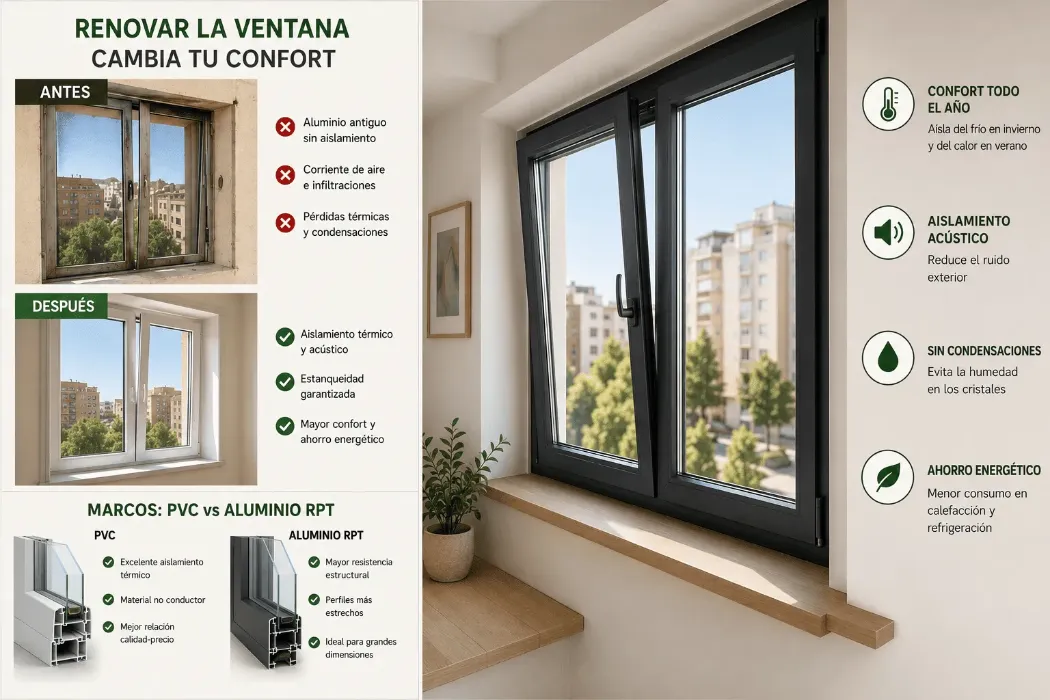
The frame supports the glass and represents between 20% and 30% of the total window area. Its intrinsic insulating capacity is measured by the Uf(frame) value:
PVC (The Cost-Benefit Standard)
- Physical behavior: PVC is a non-conductive plastic material (a natural insulator). A modern 70–76 mm deep profile with 5 or 6 internal air chambers reaches a Uf ≈ 1,1 - 1,3 W/(m2·K).
- Cost-effectiveness: It is between 25% and 35% less expensive than an aluminum profile with equivalent thermal performance.
Aluminum with Thermal Break (RPT)
- Physical behavior: Aluminum is a highly conductive metal. To insulate it, the metal profile must be interrupted and polyamide plastic strips inserted inside it.
- Performance: To match the insulation of PVC, it requires very wide thermal-break strips (30 to 34 mm), achieving a Uf ≈ 1,3 - 1,5 W/(m2·K).
- Application: Its higher cost is justified only for aesthetic reasons (slimmer and more minimalist profiles) or for large windows requiring high structural inertia.
Opening System: Casement/Tilt-and-Turn vs. Sliding
Traditional sliding windows close with brush seals that allow wind to pass through (Class 2 of permeability). To ensure optimal insulation, it is essential to install tilt-and-turn systems with pressure rubber seals, classified as Class 4 (maximum air tightness according to UNE-EN 12207).
4. Glazing Technologies: The Secret of Low-E, Argon and Solar Control
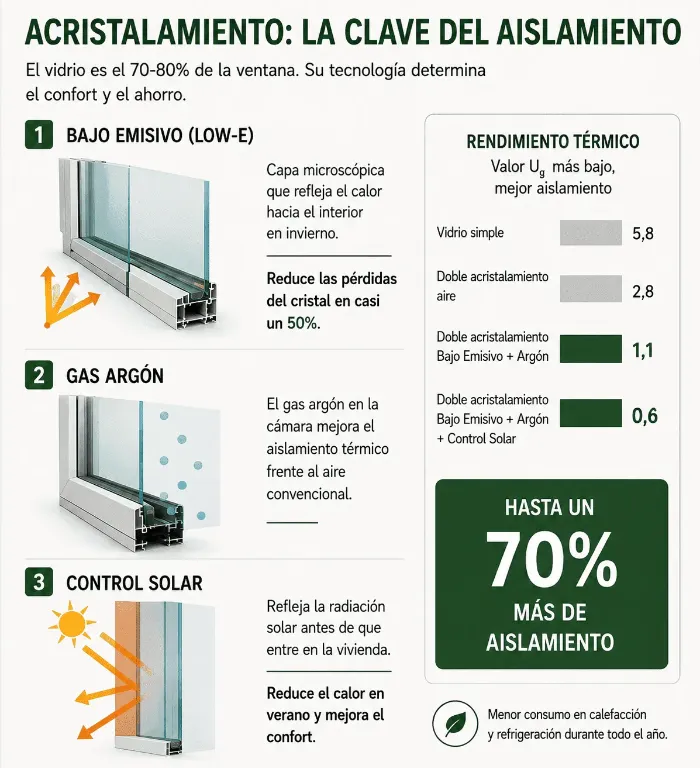
Glass accounts for 70–80% of the window. Its performance (Ug) determines most of the overall energy efficiency.
1. Low-E Treatment (Low-E)
It consists of a microscopic layer of silver and metal oxides deposited on the inner surface of the glass. It acts as a "thermal mirror" that reflects heating heat back into the home in winter. It reduces heat loss through the glass by almost 50% for a moderate additional cost of €20 to €35 per window.
2. Argon Gas Injection
Instead of leaving conventional dry air in the intermediate cavity of the double glazing, Argon gas is injected (an inert gas denser than air). This slows internal convection within the cavity, improving thermal insulation. Its additional cost ranges from €15 to €25 per window.
3. Solar Control (Commercial brands: Guardian Sun, Climalit Planitherm 4S)
In regions with high solar radiation such as Murcia and Alicante, simple Low-E treatment is not enough: in summer it allows solar radiation to pass through, creating a strong greenhouse effect. Solar Control technology is essential in the Mediterranean climate, as it blocks up to 60% of direct solar radiation (solar factorg \approx 0,38), keeping rooms between 3 °C and 5 °C cooler during the summer months and radically reducing air-conditioning use.
5. Comparative Analysis of Models and Market Costs
To analyze the market realistically, we evaluate 4 typical configurations for a standard bedroom window measuring 1,20 m × 1,20 m (1,44 m²), including frame, glass, insulated roller shutter monobloc box, aluminum roller shutter with polyurethane and complete installation (removal of the old unit and sealing):
| Window Configuration | Transmitancia (Uw) | Air Tightness | Approx. Window Cost (1,44 m²) | Coste / m² | Cost-Benefit Assessment |
|---|---|---|---|---|---|
| 1. Basic Sliding Aluminum (No RPT + Single Glass 4/12/4) |
3,8 - 4,5W/(m²·K) | Poor (Class 2) | 380 € | 264 €/m² | Very Poor: Investment does not pay off; air losses and massive heat gain persist. |
| 2. PVC Tilt-and-Turn "Sweet Spot" (70mm PVC + Double 4/16/4 + Low-E + Argon + Solar Control) |
1,1 - 1,3 W/(m²·K) | Excellent (Class 4) | 660 € | 458 €/m² | THE BEST (OPTIMAL): Perfect balance for Murcia and Alicante (insulation + summer solar protection). |
| 3. Passivhaus Triple-Glazed PVC (82mm PVC + Triple 4/14/4/14/4 + 2x Low-E + Argon) |
0,8 - 0,9 W/(m²·K) | Excellent (Class 4) | 890 € | 618 €/m² | Good (Cold areas): Excessive for mild climates such as the Levante coast due to its higher cost. |
| 4. High-End RPT Aluminum (Design) (High-performance RPT + Double glazing with Solar Control) |
1,3 - 1,5 W/(m²·K) | Excellent (Class 4) | 1.150 € | 798 €/m² | Exclusive: Minimalist aesthetics and great robustness, but a high price per square meter. |
6. Return on Investment (Payback) for a Complete Apartment (5 Windows) in Murcia / Alicante
We evaluate the replacement of 5 windows (7,2 m² of frame/glass area) in an apartment located in the Mediterranean climate zone of Murcia or Alicante (zone B3/C3), where demand combines moderate winter heating and high summer air-conditioning consumption. We consider a base annual climate-control consumption of 5.200 kWh/year and a realistic average electricity tariff of 0,22 €/kWh.
- Investment in Option A (Basic Standard Window - standard commercial PVC without advanced extras and conventional box):
- Total installation cost: 2.600 € (520 € por unidad)
- Estimated energy savings: 1.040 kWh/año (20%)
- Annual financial savings: 228,80 € / año
- Overall return on investment (Payback): 11,4 años
- Investment in Option B ("Optimized Sweet Spot" Window - PVC + Low-E + Argon Gas + Solar Control + Insulated Monobloc Box):
- Total installation cost: 3.300 € (660 € por unidad; un incremento de 700 € en el total de la obra frente a la Opción A)
- Estimated energy savings: 1.820 kWh/año (35%)
- Annual financial savings: 400,40 € / año
- Overall return on investment (Payback): 8,2 años
The real profitability of the climate-control extras: Investing 700 € additional for the entire apartment (+140 € per window) to incorporate Solar Control treatments (Guardian Sun / Climalit 4S), the Low-E coating, Argon Gas and the Insulated Box generates an additional saving of 171,60 € each year on the electricity bill. This means that the additional cost of the extras is fully recovered in just 4 years, guaranteeing absolute thermal comfort and protecting the home against future increases in energy costs.
7. Personal Income Tax Deductions and Renovation Grants
Window replacement is one of the simplest measures for qualifying for national personal income tax deductions for energy-efficiency improvement works in the primary residence:
- 20% deduction (up to €1,000 annually): For works that reduce the home's heating and cooling demand by at least 7% (comfortably achieved in Murcia or Alicante when installing PVC windows with Solar Control and Low-E).
- 40% deduction (up to €3,000 annually): For measures that reduce non-renewable primary energy consumption by 30% or improve the home's energy rating to class "A" or "B".