Within the energy envelope of a home, the pipework for domestic hot water (DHW) is one of the largest sources of "invisible" losses. In residential architecture across Murcia and the Costa Blanca, Polypropylene Random Copolymer (PPR) has become the standard material thanks to its complete resistance to corrosion and its excellent behaviour with the hard, calcareous water of the region. There is a myth, however, that because it is a plastic material PPR does not need an insulating sleeve. Although it conducts heat much more poorly than metals, an uninsulated PPR network still causes a continuous waste of energy.
Since the pipe runs are embedded in walls, slabs or suspended ceilings, insulating them requires unavoidable building works. For that reason, this energy-efficiency measure is only feasible in two very specific scenarios: new-build construction — where it must be demanded as a technical standard before walls are closed up — and full refurbishments, where opening up the chases provides the unique window of opportunity to sleeve the installation.
1. The unique opportunity: new build vs full refurbishment
Since the pipework is hidden behind tiling or mortar, the homeowner or developer must plan the insulation of PPR pipes as part of the construction process itself:
- In new build (a quality requirement): During the execution phase, PPR pipes are often installed bare or with just a 2 mm corrugated tube for mechanical protection. It is essential to demand, before closing up suspended ceilings and chases, that the DHW network is fitted with the thermal-insulation sleeve required by law.
- In a full refurbishment (the key moment): When bathrooms, kitchens or the layout of a home in Murcia or Alicante are being completely renovated, the walls are exposed. This is the only moment in the useful life of the property at which sleeving the PPR pipes represents a negligible cost compared to the energy benefit it will deliver over the following decades.
2. The physics of PPR: why does it still lose heat?
PPR (Polypropylene Random Copolymer) is a material that, in itself, conducts heat far less than copper. However, it is not an insulating material. That is why a PPR pipe also loses heat when it carries hot water. The difference between materials is easy to understand by comparing their ability to transmit heat:
| Material | Approx. thermal conductivity | Behaviour |
|---|---|---|
| Copper | 380 W/(m·K) | Conducts heat very strongly |
| PPR | 0.24 W/(m·K) | Conducts little heat |
| Insulating sleeve | 0.035 W/(m·K) | Minimal loss |
Although PPR conducts heat 1,500 times worse than copper and its walls are thicker (3.5 to 4.2 mm), the difference between leaving it bare and insulating it is still enormous:
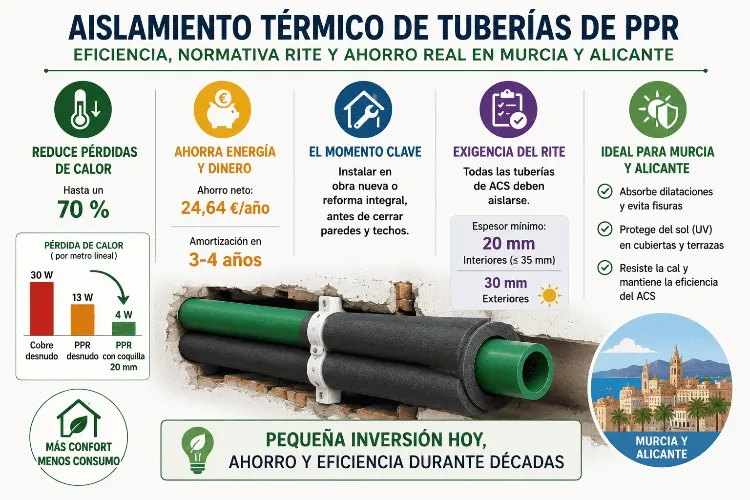
- Bare 22 mm copper pipe: loses approximately 30 W per metre.
- Bare 25 mm PPR pipe: loses approximately 13 W per metre.
- PPR pipe with 20 mm sleeve: loses approximately 4 W per metre.
In summary: Bare PPR reduces losses compared to metal, but it still wastes three times more energy than if it is sleeved with the corresponding pipe insulation sleeve (coquilla).
3. PPR specifics in the climate of Murcia and Alicante
In the Spanish Levante, the use of PPR sleeved with a pipe insulation sleeve brings specific technical solutions to the constraints of the area:
- Absorption of expansion in chases: PPR undergoes notable longitudinal expansion when carrying water at 60 °C. The elastomer sleeve not only insulates but also acts as an elastic jacket inside the chase, absorbing the thrusts to prevent stresses in the tiling or the mortar.
- Protection against UV radiation outdoors: On the roofs and terraces of Alicante and Murcia, PPR pipes connected to solar thermal panels or heat pump (aerotermia) systems suffer rapid degradation from direct sunlight. On these runs, the insulating sleeve must include a mandatory protective aluminium cladding resistant to UV rays.
- Immune resistance to limescale: Unlike copper or iron, the smooth surface of PPR prevents the hard water of the Segura or the Alicante coast from forming scale, keeping the useful cross-section and the efficiency of the hot-water flow intact.
4. Regulatory framework: RITE requirements (IT 1.2.4.2.1)
The Spanish Regulation on Thermal Installations in Buildings (RITE) makes no exceptions based on pipe material: all hot-fluid pipes must be insulated.
Minimum thicknesses required for PPR in DHW (40 °C to 60 °C):
- Indoors (suspended ceilings and chases): For typical residential diameters (35 mm), the law requires a sleeve at least 20 mm thick with a reference thermal conductivity of 0.040 W/(m·K).
- Outdoors (roofs and terraces): The thickness must be increased by an additional 10 mm (minimum 30 mm) and there must be a watertight protection against the weather.
5. Financial analysis and adjusted return on investment
Let's evaluate the impact of insulating 20 metres of main PPR DHW pipework in a single-family home in Murcia or Alicante. For this calculation we assume a realistic usage pattern in the Levante region, where hydronic central heating is almost non-existent and demand is focused on DHW, with an estimated use/recirculation time of 2.5 hours a day (912.5 hours/year):
| Parameter | Bare PPR (no sleeve) | Insulated PPR (20 mm sleeve) |
|---|---|---|
| Linear thermal loss | 13 W/m | 4 W/m |
| Total loss (20 m of pipe) | 260 W (0.26 kW) | 80 W (0.08 kW) |
| Annual loss consumption (2.5 h/day) | 237.25 kWh/year | 73.00 kWh/year |
| Annual financial cost (€0.15/kWh) | €35.59/year | €10.95/year |
| Net saving generated | — | €24.64/year |
Payback:
- Extra cost of material and installation in an open chase: approximately €85
- Payback time: 3.45 years
Even in a warm climate like Murcia or Alicante and with moderate daily hot-water use, fitting the pipe insulation sleeve pays for itself in barely three and a half years, delivering a net saving over the following decades.
6. Recommendations for on-site inspection
If you're building your home or carrying out a full refurbishment, verify the following points before the walls are closed up:
- Check the actual thickness: The sleeve must have an insulating foam wall at least 20 mm thick; avoid thin covers of just 2 mm.
- Sealing of joints: The joints between sleeves and the heat-fused PPR elbows must be sealed with self-adhesive tape of the same material to avoid thermal bridges.
- Roof protection: On external runs feeding solar or heat pump systems, the sleeve must have metallic or aluminium protection resistant to the Levantine sun.